When Entryway Storage Turns Against Your Door’s Strength
Over-the-door organizers suit only doors with robust hinges; once loads exceed capacity, jams and resets increase, unlike anchored wall storage.
It surprised me how quietly the warning signs appeared. A door that used to click shut began catching, just barely—not every time, but enough to make you pause, hand on the knob, nudging it past a new stiffness. That was the earliest hint that something in the flow of the entry had shifted. Over-the-door storage seemed clever at first, with shoes tidied high and hats out of the chaotic mudroom drift, but gradually, I could feel the cost building at the threshold.
Noticing the Strain Where You Stand
You don’t notice it immediately. The first few weeks, stacked racks and patterned pockets promise relief from the usual pile: bags off the floor, gloves remembered, walkways clear enough to breathe. But there’s a difference between looking neat and staying easy to use, especially through winter evenings or school-run mornings.
I remember seeing the row of shoes below the door widen week by week, pairs spreading out after the smallest nudge—like they knew the order above couldn’t quite hold. Doors hinge for passing through, not for carrying the weight of repeat arrivals. The drag grew subtle: a little more resistance with every load, a new softness in the door swing, and a sense of pressure—literal, somehow—where people, shoes, and gear kept crossing paths. You feel it.
That was the part I kept coming back to: how much ease can quietly disappear, beneath the surface.
Movement and Stability—Who Carries What
The more the over-the-door pockets filled, the more I found myself slowing down—sometimes just to get in or out, sometimes to chase a shoe that dropped away from a bump. There’s a threshold tension in busy homes, and swinging storage doesn’t absorb it so much as shift it around. All it takes is one quick drop-off, one heavy bag after a thunderstorm, and the next day the rack hangs lower. It’s not dramatic. Sometimes all you hear is a small hinge groan or the sound of a door shifting against its frame.
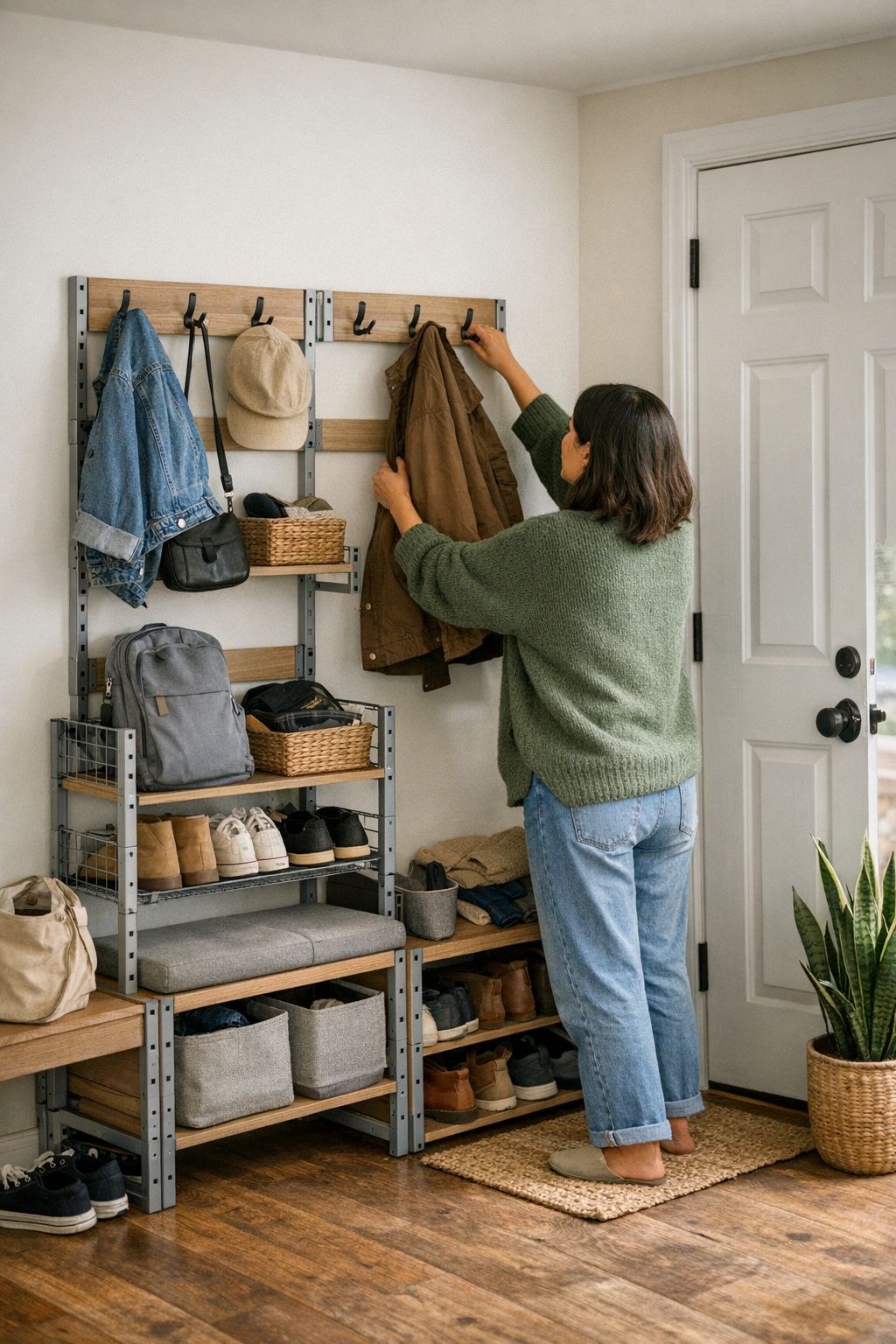
Eventually, I shifted a few key items to a wall-mounted utility rack and set up a narrow bench where shoes could live between outings. Suddenly, there was less hesitance crossing the entry. Everyone could move at their own speed. With the weight off the door, the reset became almost automatic—bags settled into their places, nothing dragging or tipping from above. I hadn’t realized how much of the entry’s pace was set by what it had to carry.
When the Setup Finally Fits How You Move
There’s a small kind of calm that comes when transitions just work. Usually it makes no noise at all. The difference appears in routines, in the ease with which a bag lands on its hook or a coat slides into reach. The old pressure fades; door swings feel lighter, and shoes line up without migrating to awkward angles.
Looking around after a month, I didn’t miss the “quick upgrades” that never lasted. I settled into the idea that storage is less about filling space than releasing a bit of it—making room for all the comings and goings, not just the things themselves. For anyone who feels the ordinary stress of a blocked passage or that quiet dread of another dropped organizer, it turns out structure—even in the simplest form—invites a more lasting kind of order.
For more thoughts and options from this in-between zone, there’s always something new turning over at http://www.betweenry.myshopify.com.



