When Fatigue Turns Rivets Awry at the Workshop
Rivet head misalignment occurs after repeated use; visibility and steadiness during placements prevent drift and finish defects.
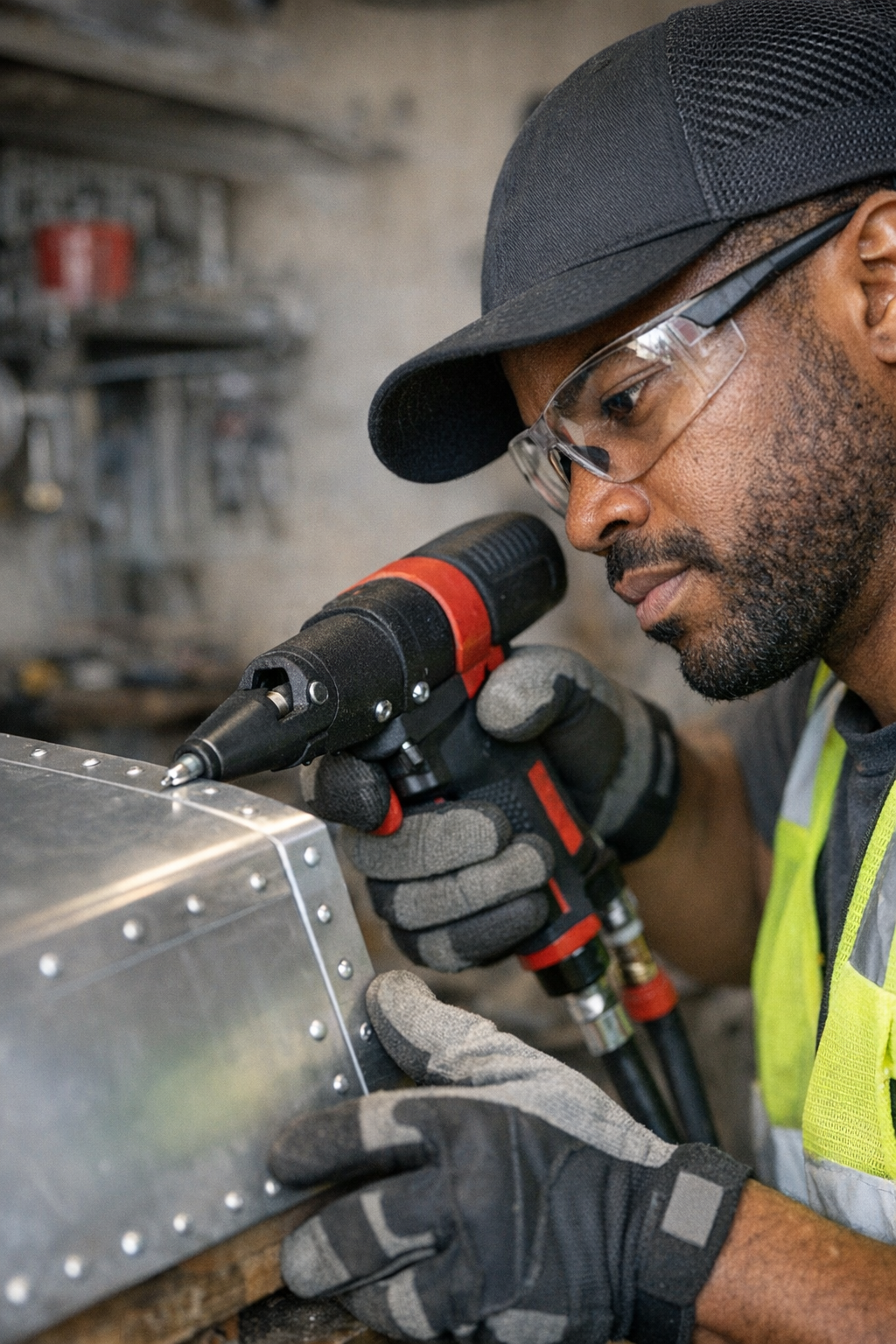
You don’t really notice it at first—a rivet head set just a tiny bit off. Sometimes, work keeps moving, and you believe everything’s aligned the way it should be. It’s only later, when your arms begin to tire, dust starts to settle, and lines no longer run straight, that the small flaws start to surface.
This is what happens when rivet guns fail to keep up—not in power or comfort, but in the quiet detail of repeated, real-world accuracy. So much of shop work depends on the ability to seat a rivet head perfectly, again and again, even when your hands are tired and light’s running low. The challenge isn’t always visible. But you feel it.
Where Misalignment Starts
Problems don’t always announce themselves. The first dozen rivets might look perfect—a line, a rhythm, a job unfolding as planned. But fatigue grows in the hands faster than you expect. A single angle shifts. A tool vibrates. Suddenly a row of heads sit not quite right, just off the intended seam.
The real difference between rivet guns isn’t always about how ergonomic the handle feels, or how impressive the specs seem in a catalog. It’s about how reliably you can see the work, especially from odd positions or after hours of repetition. When vision gets blocked or a nosepiece is too bulky, tiny errors creep in unnoticed until they’re a pattern.
You don’t notice it immediately. But you feel it.
The Accumulation of Small Flaws
It’s a strange thing—how misplaced confidence in a familiar tool can lead to extra hours hunched over sandpaper or reworking seams. I’ve watched stray rivet heads turn smooth joints into rough repairs, adding the kind of hidden labor that rarely shows up on a project sheet. There’s a difference between a row set flush and a row that demands double passes and cleanup.
One afternoon, moving between bench work and overhead panels, it became clear: the moments when you can’t see the rivet seat directly are when mistakes creep in. A millimeter out of line, repeated enough times, builds up into work you feel in your back and your wrists.
Sometimes, it’s not about pushing harder—but seeing more clearly.
A Shift in Perspective
Not long ago, I tried a rivet gun with a narrower nose and a small sight window above the die. A small design change—just a few millimeters’ difference—meant I could see the head and hole from difficult angles, even when tired. I found myself breathing easier, less likely to drift or twist just to catch a glimpse. The pace slowed, but so did mistakes.
What I learned isn’t listed in a manual. Specs and ratings don’t account for the way small features add up, or how often a task turns into rework because something as simple as visibility was missing.
A tool that preserves clarity—even after sixty placements, even as fatigue sets in—becomes less about specs and more about trust.
These thoughts settled in while patching a weathered shed panel, considering if maybe, sometimes, small adjustments are the ones that matter most.
This was on my mind during a hands-on rivet gun review for Shopify.