When Light Shapes Space: Finding Corners in Everyday Rooms
Corners, edges, and surfaces vanish with diffuse ceiling lights; linear and panel lights restore boundaries, improving work clarity and navigation.
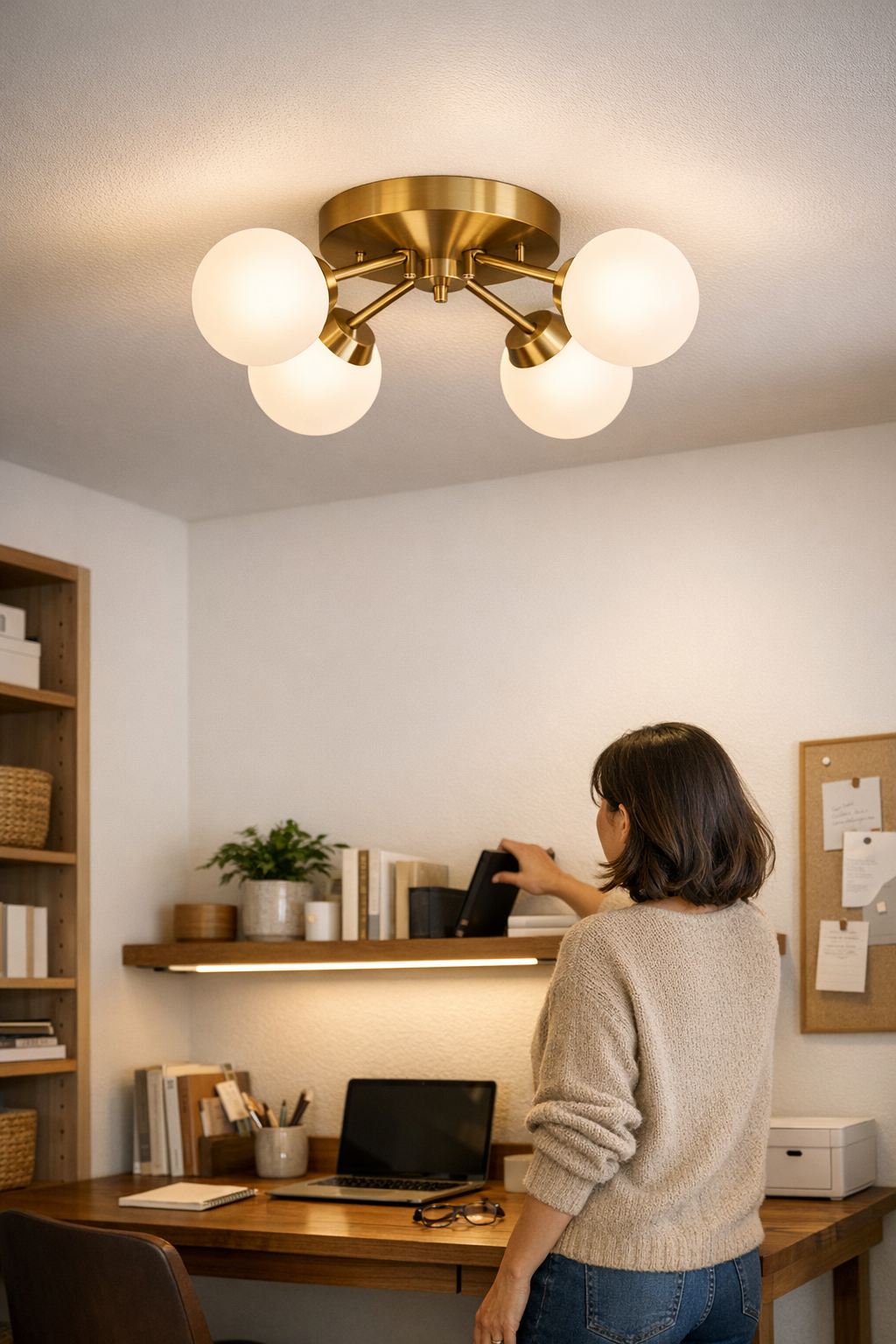
There’s something slightly uncanny about a freshly lit room with a large ceiling fixture. At first, everything appears so even—neutral and “finished”—that you hardly notice what’s quietly missing. The odd thing is how quickly that flatness settles in. One evening, you sit at your desk and see how every surface shares the same tone, how the far corner looks just as flat as the spot directly beneath the light. Surfaces merge together. Edges soften, then gradually disappear.
A room lit this way works, technically. Still, after a few days, corners fade, and it becomes tricky to see where floor meets wall or where a shelf actually ends. You don’t notice immediately. But you feel it.
Boundaries Gone Soft
After several evenings at the same table, I realized that a broad flush-mount ceiling light washes away the lines that help you orient yourself in a space. I’d find myself slowing down to check if my laptop charger had slipped off the far end, or reaching out for a misplaced cable I was sure I’d left on the edge—except the edge no longer caught my eye.
Corners don’t vanish all at once, but through a subtle, gentle erasure. The shelf blurs—its boundaries unclear, its usefulness diminished. It’s only small things at first, but each time I walked through the room, I noticed a quiet effort to reorient, to keep track of where things ended or began.
That was the part I kept coming back to.
Surface Clues
Linear and panel lighting interact differently with a space. Switching from a basic ceiling disc to a 120cm LED panel above the desk didn’t produce a dramatic change, but it felt immediately relieving. The corners felt present again. There was softness, yes, but also a quiet navigation cue—edges defined just enough so spotting a notebook or seeing where the desk turned into shelf happened almost without thought.
One evening, I found a stray cable tucked neatly beside the wall and realized I didn’t have to squint or second-guess where it was. The line between work zone and storage felt clear. Light grazing parallel to the wall restores those critical surface clues—a welcome distinction that doesn’t glare or wash everything out.
This wasn’t about making the room brighter. It was about restoring recognizable places inside the room.
Subtle Supports
Looking up, I saw how mounting and cable management mattered beyond what I’d expected. Securing the panel snug to the ceiling and routing cables so they slipped unobtrusively out of view kept my eye from being drawn repeatedly to overhead distractions. The ceiling stayed clean. Below, surfaces felt more open and easier to use.
The room, for all its minimal lines, felt quietly sharper—mentally easier to inhabit day after day. It’s the kind of shift you notice in small, repeated ways: papers finding their spots, less fumbling on the margins, a calmer route from desk to shelf, wall to door.
Sometimes it’s not about how evenly the light falls. It’s about how much of the room you get back once you can see its boundaries again.
There’s more to explore if you’re curious: http://www.lightsupport.myshopify.com