When Lighting Demands Stretching, Something’s Off
Stretching for indoor lights signals poor fixture placement, increasing risk. Small repositioning improves safety and ease of routine maintenance.
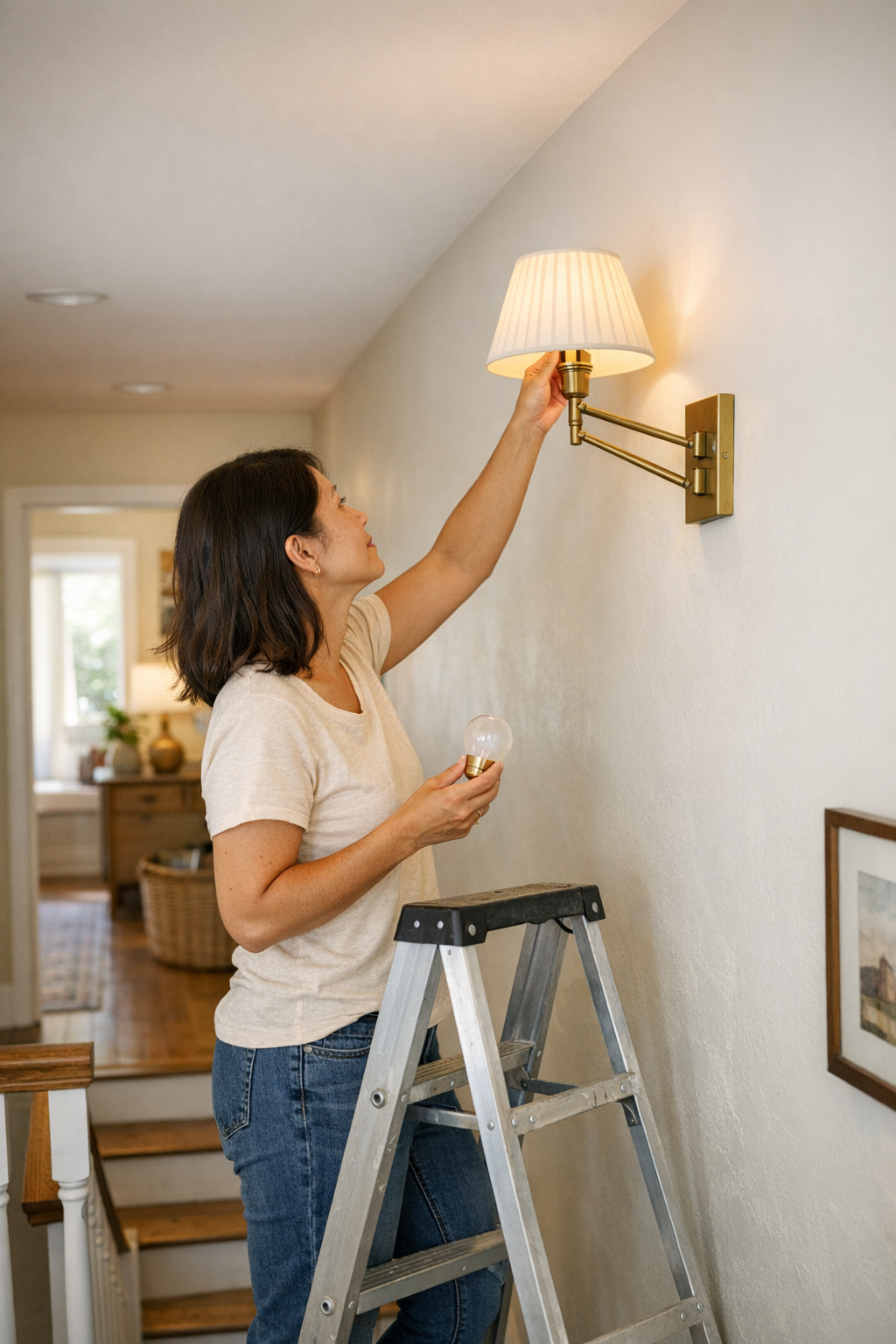
There comes a point in the life of a home—sometimes sooner, sometimes quietly much later—when lighting stops being about its appearance and becomes about how you move through your days and nights beneath it. That brief stretch across the laundry room when reaching for a wall sconce, or a semi-flush ceiling fixture hovering just beyond comfortable reach on the stairway landing. At first, these feel like minor inconveniences, easy to brush off. But over time, they grow into moments you quietly dread. You don’t notice the problem immediately. But you feel it.
It goes unnoticed, until it doesn’t
I used to think the core issue with utility lighting was simply unevenness—chasing away shadows in hallways, navigating entryways lined with reflecting mirror wall sconces, or fumbling through dim stairwells. What I didn’t realize was how easily ease of use quietly fades when a ceiling panel or wall light sits out of practical reach. The compromise starts small: a skipped cleaning, a dim bulb left longer than it should be. The fixture still glows, so you move on. But each difficult reach builds a hesitation, making maintenance a chore.
It’s surprising how a lighting flaw can hide behind its own brightness. The light itself may be clear and bright, but what’s really troublesome is what it demands of you to keep working—bulb changes, dusting, adjusting. That was the problem I kept coming back to.
Routine shapes the meaning of “problem”
Sometimes late in the evening, I catch myself pausing under the light at the bottom of the stairs, where a semi-flush ceiling fixture hangs just at the edge of reach. When it’s working properly, you cross without a thought. But when it flickers or dims, replacing the bulb becomes a calculated risk—an old uneven step, a quick mental note about whether to drag out a ladder or just wait a bit longer.
Everyday movement through those in-between spaces—under-cabinet shadows in the kitchen, a task light set too far back on cluttered surfaces, the harsh glare or washed-out reflections over a bathroom mirror—quietly reveals where lighting shifts from help to hassle. Over time, I stopped thinking about whether a light looked “nice” and started noticing where I delayed repairs with weak excuses of busyness that really masked a small fear of falling or fumbling. The difference wasn’t just comfort; it was whether the fixture slowed and complicated my routine, or seamlessly supported it.
Small changes, bigger relief
I once moved a stairway light just 18 inches—from the floating center of a landing to a spot nearly above the handrail. Living with years of teetering, reaching, and balancing made this modest move feel surprisingly significant. Same brightness, very different ease of use. Bulb changes became simpler, dusting easier, and even walking the stairs at night felt safer and more natural. Nothing else changed about the space except how easily I cared for the light.
You don’t notice the importance of reachability until you do. When a fixture sits where maintaining it fits effortlessly into daily life—not as a separate ordeal—something subtle shifts. The room feels more dependable; your movement in it becomes automatic again, not a cautious calculation.
Most lighting decisions focus on symmetry, coverage, and an even spread—a centered glow intended to balance the space. But what I keep returning to is this: reliability sneaks in when maintenance fits naturally into your steps, when changing a bulb or cleaning a surface never demands acrobatics or workarounds. That’s when you stop dreading those tasks, and lighting truly starts to work for you.
If you’ve ever wanted to see how these practical choices play out in real homes—considering flush mount and semi-flush ceiling lights, wall sconces, hardwired wall lights, vanity and mirror lighting, entryway and hallway fixtures, stairway lighting, under-cabinet and fixed task lights, bathroom-rated and damp-rated indoor fixtures—LightHelper quietly catalogs the details here: http://www.lighthelper.myshopify.com



