When Movement Matters More Than Order in the Workshop
Switching to a mobile cart improves movement efficiency, reduces clutter and reshuffling, and speeds up resets in daily routines.
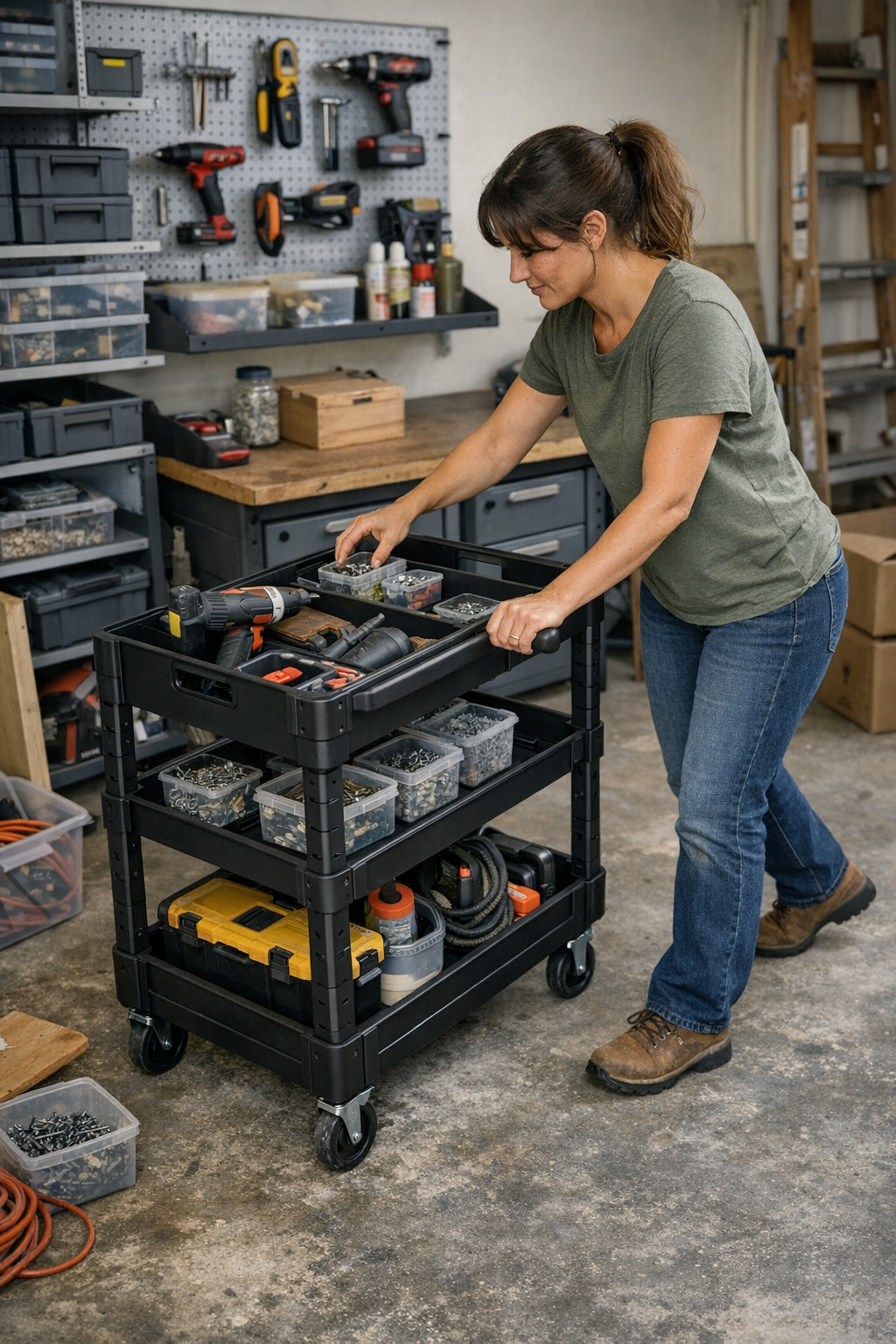
It’s surprising how calm a workspace can feel when everything is put away—bins nested on shelves, labels facing out, barely a stray screw in sight. It feels good and complete. Yet, when you’re in the middle of a task, hands full, and realize the tool you need is on the other side of a cabinet door, that calm fades. You don’t notice the friction until your workflow stutters.
This is the core challenge with workspace storage in setups like garage workshops, backyard utility areas, or small workspaces: it’s not just about how organized things look or how many bins you have. It’s about how those storage spaces move with you—or block you—once actual work begins. Wall-mounted shelves and fixed cabinets impress at first glance, but as projects pile up, mobility matters more than neatness.
Where Routine Meets Resistance
You might not notice the inefficiencies right away. The double carrying. The back-and-forth trips between zones for parts you forgot or tools you set down in haste. Walking loaded across the floor only to realize you left something behind slows down the entire process.
Ironically, even the tidiest systems can create clutter. Resetting your space takes longer, and overflow tends to gather in unexpected corners. I’ve seen more unused “dead spaces” in well-organized workshops than in cluttered ones. The problem isn’t tidiness itself—it’s that fixed storage tethers your flow, chaining every step to a static spot while your work moves elsewhere.
Fixed Order, Fluid Needs
Not long ago, I spent a frustrating hour ferrying drill bits and fasteners between two fixed cabinets for a quick install near a far door. Each trip felt minor alone, but by the third kneeling pass, I realized the neat wall setup was forcing me into unnecessary laps. The system was orderly, but my workflow was chaotic.
It’s a quiet frustration. First, stepping over a box out of place, then digging behind a pile that wasn’t there this morning. The space looks controlled, but it costs real time—retracing steps, unstacking and restacking, never quite staying a step ahead.
Much of daily work is shaped by these invisible efforts. It becomes background noise—until something shifts, and you notice the difference.
The Quiet Shift of Mobility
Moving my core tools to a rolling cart changed the game. It wasn’t just “handy.” The change was calm, smooth. No split-second detours, no piles collecting in unused corners. The cart moved with the project, not against it. Resetting the workspace happened naturally in the pauses between tasks, not after frustrations boiled over.
Some of the smallest routine changes reveal which problems were real all along. I still rely on wall cabinets for big, bulky, or rarely used supplies. But for daily tasks, a mobile cart keeps flow moving ahead of friction. It quietly staves off the slide from “organized” into “stuck.”
What surprised me was how automatic the reset became. The items I used most returned on their own—not because I forced it, but because the cart was always nearby, following the work.
The real lesson only came after I paused to listen to how my space actually felt during use, not just how it looked on day one.
These thoughts came together while reorganizing my own often-overlooked workspace. Here’s a look at how that project unfolded.



