When Neat Lighting Starts to Drift in Everyday Spaces
Lighting alignment looks easy initially but needs secure brackets and proper cable support to prevent drift, glare, and clutter over time.
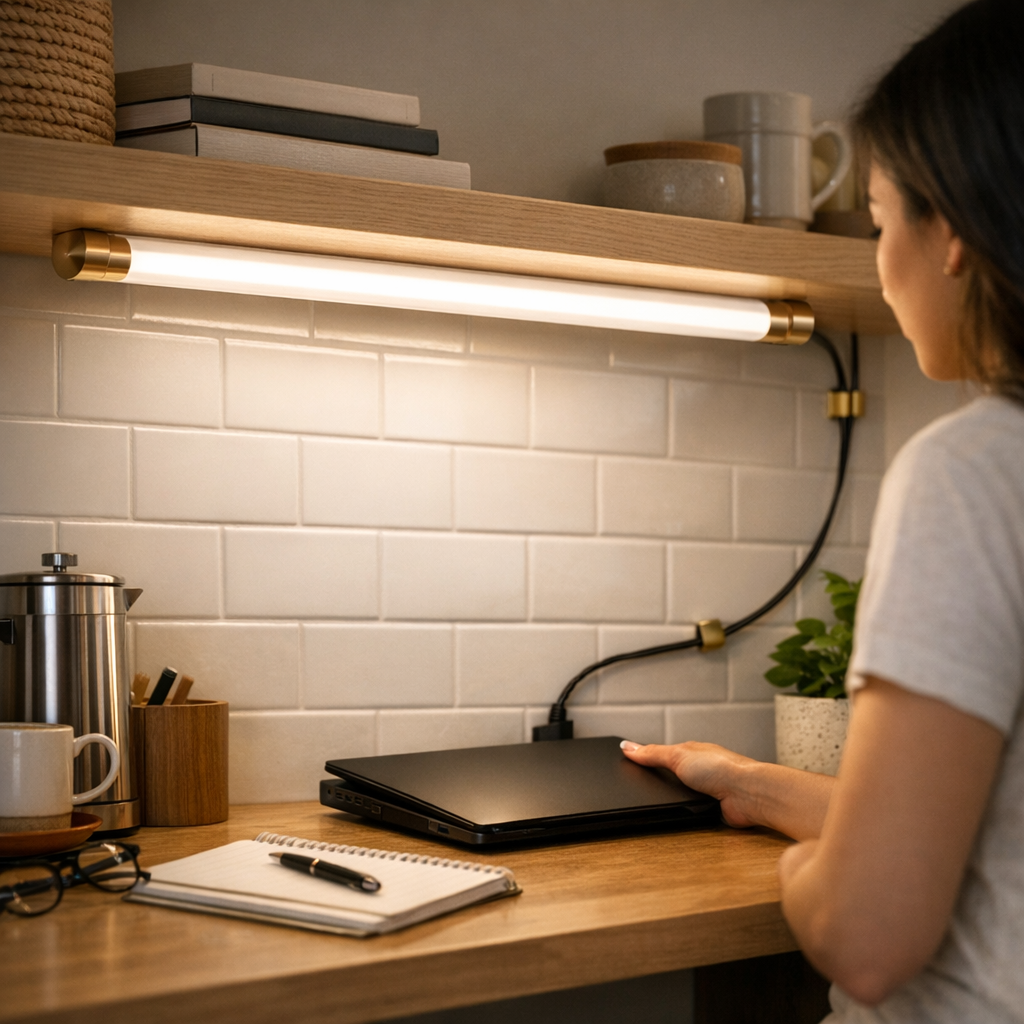
There’s a particular edge-of-evening feeling when you sit down and notice that the lighting in a room has shifted—not just in color or brightness, but in alignment and presence. Maybe a cable nudged loose after another busy week, or an LED bar on a shelf starting to tilt. What looked seamless on day one begins to show its seams. Small imperfections edge into your daily routine. You wonder how it felt so tidy to begin with, and when exactly it began to unravel. I kept coming back to this, watching my own workspace quietly change, fixture by fixture.
The Moment When Things Stop Lining Up
This shift doesn’t happen all at once.
There’s the first week, when everything is crisp—cords routed close to the wall, task lights gliding exactly where you want them. Maybe you catch yourself admiring how a cable disappears beneath a bench or how an overhead strip holds perfectly flush.
But then, someone bumps a desk. A notepad slides, tugging a lamp’s wire visible out of its groove. I noticed the under-cabinet light in the kitchen slipped out of level during a quick cleanup, leaving a thin shadow at one corner. You don’t notice it right away, but you feel it.
Fitting Real Life Back Around the Light
I began catching these small misalignments more often—a drooping cable by the wall, a panel slightly askew above eye level. The shifts weren’t dramatic, but they disrupted the flow of the room. A work light that was once reliable now left half a page oddly dark; a shelf LED no longer spanned the countertop evenly.
The pattern was subtle but consistent. No matter how precisely a fixture was installed, something would move. Reaching for a book, plugging in a phone, dusting the surface—actions that once seemed harmless now challenged the supports that had felt secure. I kept fixing the same cable, straightening the same light. That part stuck with me.
Eventually, I adjusted where clamps sat and swapped clips for brackets that locked firmly on both ends. The difference was quiet but lasting. The lines stayed where they belonged, without daily readjustment.
The Quiet Cost of Just Looking Good
Chasing only a clean first impression—slim brackets, floating lines, cables hidden out of sight—is an easy mistake. Spaces live differently than they’re photographed. Weak support means more than a drooping fixture; it’s glare catching your eyes again, a plug stretching awkwardly across a shared table, or an unlit gap at the edge of your work zone.
Sometimes, the fix is as simple as moving a clamp to where a cord meets the trim instead of hiding it farther out of reach. Sometimes it’s choosing a bracket that actually locks down rather than one that just looks invisible.
I’ve learned that the right support—placed for real use, not just appearance—is what makes a space hold together quietly, no matter how often the room is rearranged or lived in. A desk, a hallway, a kitchen: each reveals the test in its own time. Fixing those small details doesn’t announce itself, but you feel the difference the moment you sit down and everything is as it should be.
If you find yourself noticing similar shifts, there’s a place with solutions I circled back to more than once: lightsupport.myshopify.com