When Organized Bags Turn Against You on the Go
Unpacking feels harder than packing because carry-on order breaks down under repeated movement and pressure, causing delays and friction.
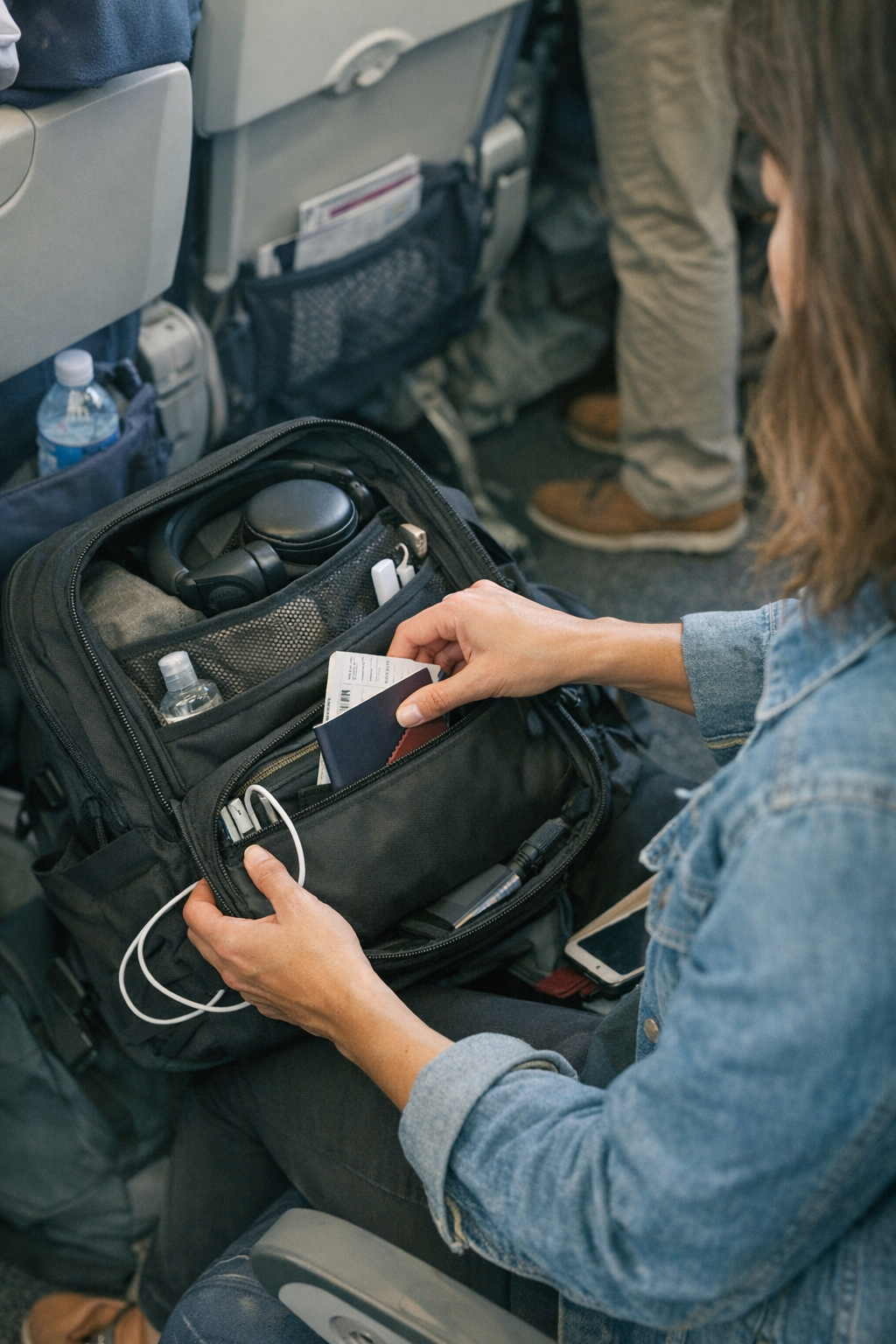
It was always neat at home. Every travel routine began with quiet arrangement—pouches stacked flat, chargers folded tight, documents zipped just so. There was a small satisfaction in it. Off the floor, the bag looked orderly and purposeful. Still, that image rarely survived the first checkpoint.
You notice it after a few transitions. The careful grid you set up at home loses its shape as soon as the bag is squeezed between your legs or shifted sideways into an overhead bin. What made sense unpacked on a table slows down under pressure—especially the third or fourth time you reach for the same item.
Where Order Fails in Motion
What looked fine at first quickly shifts when you’re moving. The outer pocket that seemed perfect at home ends up crowded with receipts, random keys, and small clutter. Pouches stacked neatly slide just enough to block something underneath. At the airport, especially in security lines, there’s a kind of frustration in sorting through a bag that was “organized” an hour ago but now feels like a tangled puzzle.
Overlapping compartments look tidy until the moment you need the document buried at the bottom or the headphones stuck behind that extra layer of toiletries. Suddenly, what should be quick access isn’t quick at all. When you’re cramped between seats or have to pull your tray table up while unpacking, you sense the gap between what’s meant to look organized and what actually stays easy to reach.
That gap is the part that keeps coming back on every trip.
Why Retrieval Becomes the Real Test
Every delay—the slow security scan, digging through the wrong pouch, the awkward shuffle as someone waits behind you—highlights the bag’s real weaknesses. None of this shows up when packing quietly before the trip, but retrieval surfaces every design flaw. Even minor snags, like a zipper catching on a shifted pouch, slow you down when time is tight.
If a bag’s order breaks down with every access, it never gets ahead of the next need. Before long, repacking feels as routine as retrieving. Every attempt to keep things controlled just stacks more layers between you and the essentials you rely on mid-journey.
The Simple Shift That Stayed Useful
What finally helped wasn’t more organizers or squeezing in extra compartments. It was moving key items—passport, charger, sanitizer—into a single shallow layer, each item reachable without unstacking or unzipping anything else. One wide, shallow pocket changed the whole pace.
After that, retrieval in cramped spaces felt less like undoing a complex sequence and more like a single smooth motion. It wasn’t perfect, but the bag stopped working against itself. Packing for movement—rather than just neatness—held up through repeated access, tilts, lifts, and seat changes that define transit.
It’s a small adjustment, but the right layout feels quieter as you move—a kind of quiet you notice most when rushing crowds and fixed airport routines don’t spill into every reach you make.
If you ever want to see some of the gear that’s held up to this, it’s easy enough to find here.



