When Pressure Wavers, So Does the Finish
Monitoring air compressor pressure stability is key for consistent finishes and faster workflow during repeated tool use.
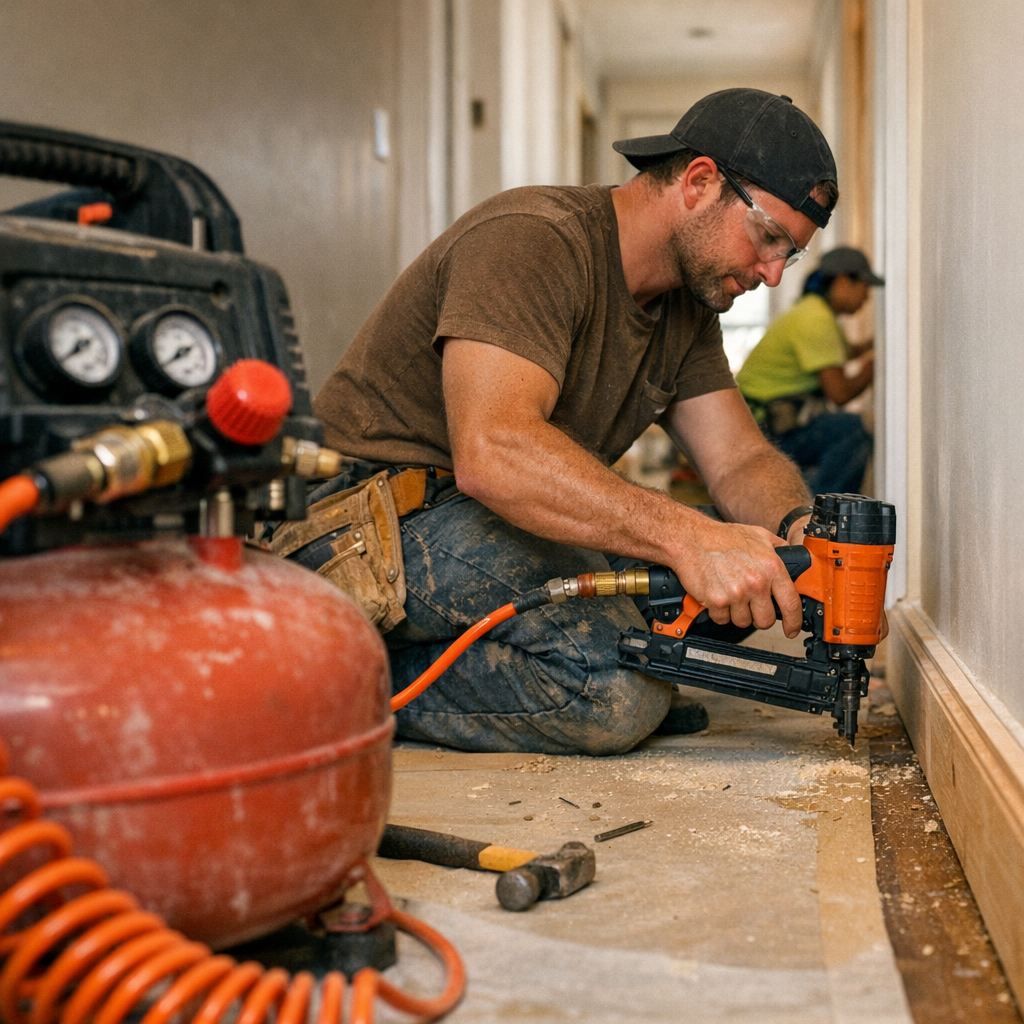
There’s a rhythm that settles in when you’re deep into a project—measuring, fitting, firing off trim nails one after another. Hours can pass lost in repetition until something barely noticeable interrupts your flow. Maybe it’s a nail just proud of the trim, a patchy line where the spray should have been smooth, or an edge demanding another round of sanding. At first, you let it pass, but gradually you start to wonder if there’s something off with your air compressor’s pressure.
Small Drifts, Big Difference
Pressure doesn’t usually command attention unless it slips. Even when the gauge claims you’re in range, small swings during steady work can slip in quietly—imperceptible from cycle to cycle, but distinct over the course of forty, fifty, or more repetitions. You don’t notice it immediately.
But you feel it.
It begins as an odd miss, a shallow staple, an imperfect seam. By the twentieth repetition, each tiny drift adds up—suddenly, routine jobs become prone to patchwork and inconsistencies. The chain reaction is subtle: a little extra sanding here, just a bit more filler there. It’s easy to blame technique or the wood, but the root can live inside the compressor, its pressure not holding steady with the demands of repeated, rapid use.
Not All Compressors Are Equal
On the surface, compressors often look identical: similar tanks, matching psi. Yet underneath, their character emerges only under pressure—literal and figurative. I’ve noticed two machines with the same stats diverge once the real work begins. There’s one that keeps the pressure loss so tight, you barely have to check. Then there’s the one that wavers—7, 10 psi swings between tasks—and everything starts needing rework.
The difference doesn’t announce itself with alarms. It arrives as small frustrations. Staples raised too high, finishes rough in the afternoon light, seams refusing to blend. It’s rarely dramatic, but the patience-reducing, time-stealing drift gathers all the same.
A shift in how I chose compressors—paying attention to delivered SCFM at the working pressure—changed the experience completely. The day I moved to a model holding over 4.0 SCFM at 90 psi, the results were impossible to ignore. My pace picked up, finishes grew cleaner, there was less end-of-day fatigue, and—almost as a bonus—the cleanup shrank to the bare minimum.
The Real Value of Holding Steady
On job sites, in workshops, or in the corners of spare rooms doubling as project spaces, pressure stability quietly shapes the outcome. It decides how many fixes happen, how often errors collect, and—maybe most overlooked—how much energy is left at the end for the last detail or just stepping back to see what you’ve made.
It’s a quiet sort of realization: not all power and specs are created equal. Sometimes, finding the tool that delivers steady pressure across repetition isn’t flashy, but it’s often the difference between job satisfaction and a string of little frustrations.
Some lessons only reveal themselves through hours spent circling the same spot, chasing a flush finish.
These thoughts took shape between long trim runs and late-evening corrections, working through projects with a new compressor at my side.