When Slow Mornings Quietly Shift the Day’s Rhythm
Morning hesitation in dogs signals a need for routine structure. One reliable cue and consistent bowl placement ease flow and reduce stress.
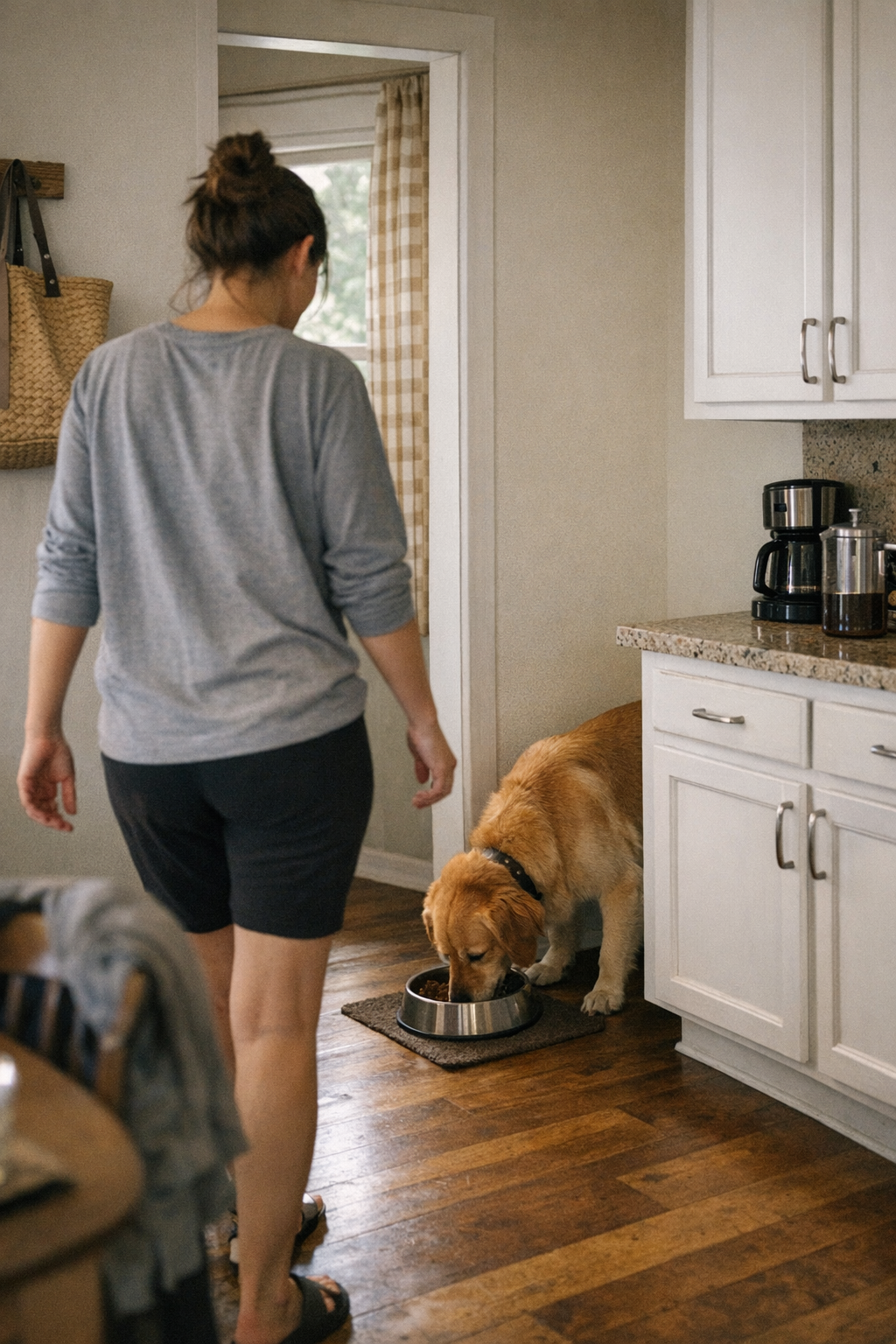
It creeps in softly—never a crisis. Just a slow shift in how the first half hour goes, a difference you only spot after enough mornings. Your dog stands expectant halfway between the door and kitchen, waiting for something. You both pause. Maybe this only costs a minute, but that minute returns repeatedly: messier feeding, slower cleanup, more nudging than you meant to give. At first, you chalk it up to their mood, their age, a weather front, but after a week you realize: it’s become routine.
We tend to overvalue tidiness when it comes to pet setups—stacking bowls neatly, lining up towels right by the door, making sure toys are corralled at night. It all looks manageable in a photo or when guests are coming, but living in the swirl of it is different. The bowl slides, the towel you meant to grab sits an inch too far, toys crowd the path to the crate. The difference between setup and use isn’t just about aesthetics—it’s about flow in the thousands of small, unremarked movements that make up a day.
You notice it after a few mornings. Everything looks fine, nothing is broken, but you’re always a beat late with the towel, or the leash catch is just awkward enough by the door to make your dog hesitate. Walking back in from outside, paws already marking the floor, you fumble for the backup towel that always ends up under the jacket you meant to hang. Each of these is a quiet ask for just a bit more attention.
Tidy Setups and Messy Returns
There’s no real ceremony in feeding a dog or guiding them back in after a wet walk. Real life doesn’t bend to plans; objects find their own places, routines get improvised, sometimes for weeks without notice. It looked fine at first—a food bowl up against the cabinet, towel basket by the entry, toys pushed to the wall.
But somehow, each piece began to stretch the routine out rather than smooth it. Bowls edged out further from the wall each week, scattering kibble into corners. My foot hit the same squeaky plush toy almost every night when turning off the lights. The towel skipped its role more mornings than not, leaving muddy paw prints to wipe up after the fact.
That was the part that kept returning—the subtle lag, not in the objects but in how each one demanded slightly more effort than planned. I stopped thinking of my house as “dog-proof” and started noticing where friction kept gathering.
When Routine Clashes With Real Life
You find out quickly that the line between “organized” and “actually easy” isn’t as thin as it looks on a good day. There’s no wrong way to keep dog bowls unless you keep tripping over them on your way to the coffee. There’s no issue with a packed toy bin, except for the night you knock half of it over with your foot. Patterns settle in without announcement.
One practical realization hit me during a string of sticky spring mornings—if the towel never gets used at the right moment, it’s less about forgetting and more about its placement. So I moved it: not to be pretty, just consistently within reach of the first paw coming inside.
The difference showed up in smaller ways than I expected—less scrambling, less stretching, and fewer muddy streaks to chase later. I wasn’t training myself really—just lowering the number of steps involved in avoiding a mess. Turns out, laying things where the living happens wins out over the look of it almost every time.
Everyday Flow and the Ease of a Good Setup
The rhythm of a dog’s day is a sequence of tiny compromises. Most don’t need over-correcting. But when you ease one repeated snag—a bowl that stays put, a towel where the door sticks, a quiet toy corner that clears the main path—you start to notice mornings running closer to how you’d like them.
It doesn’t make the mess disappear, but it keeps things from becoming a perpetual catch-up. Your dog doesn’t wait for instruction—they just move, finding things right where they make the most sense.
That was the change I kept coming back to. Not the absence of clutter, but the ease that followed its gentle repositioning. The difference between “it looked fine” and “it feels better” isn’t always obvious at first. Some mornings, the only thing you notice is the absence of stalls—the sense that the routine has returned to you, rather than the other way around.
If you’re curious about how small daily choices add up in real homes, there’s a quiet corner with more of these lived-in observations here: http://www.dogpile.myshopify.com



