When Small Shifts Turn Nighttime Into Restless Hours
Stability in indoor cat layouts reduces nightly pacing and mess by anchoring stations, making routines smoother and less disruptive.
The Quiet Cost of Drift: What Repeated Use Teaches You About a Cat’s Space
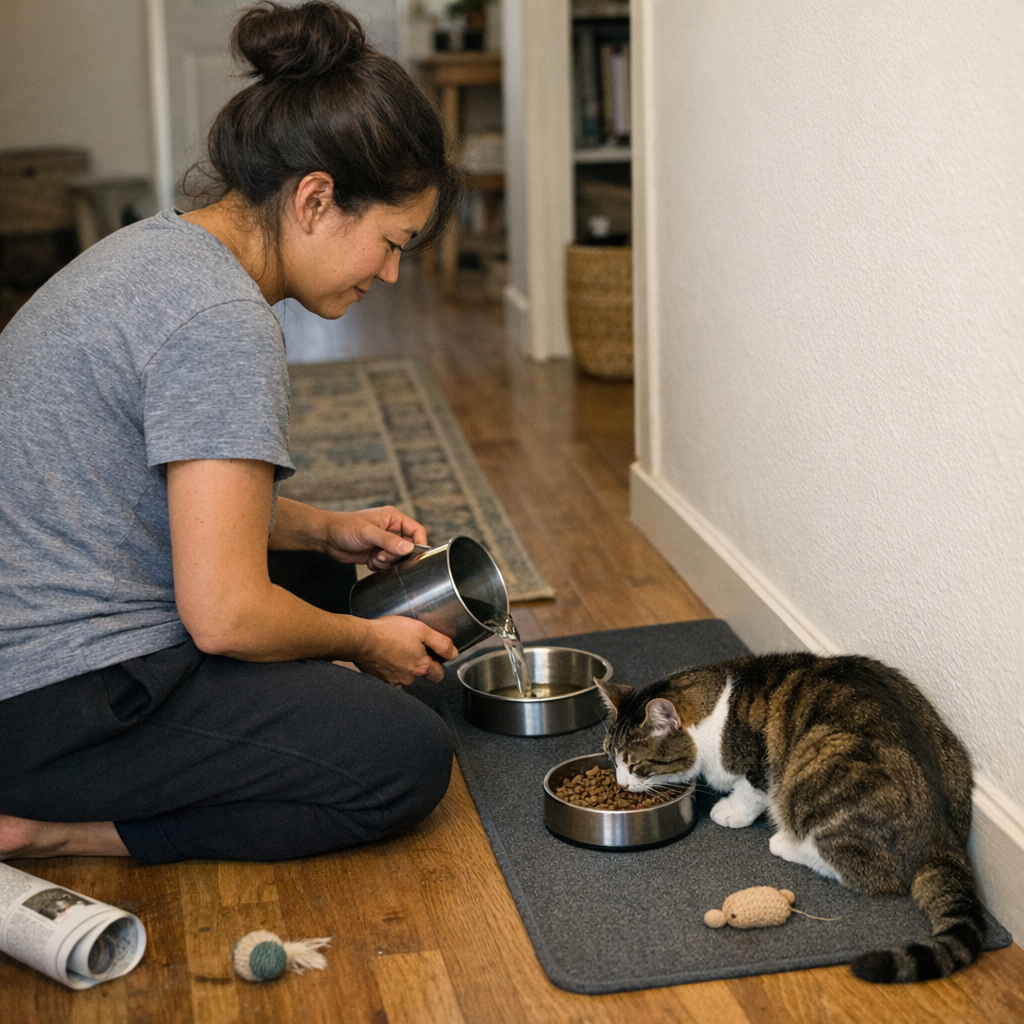
At first, it all seemed fine: just a few small corners cleared—a feeding area tucked near the kitchen, a water bowl set within arm’s reach, and one narrow mat to catch the scatter. I remember feeling quietly pleased—the cat had her zone, the house stayed mostly orderly, and a sense of calm settled over everything. But it didn’t last the night.
What Looks Settled Is Only Half the Story
You notice it after a few resets. Bowls mysteriously inch away from their starting points, mats slip and bunch, and by morning, stray pieces of kibble reappear where you thought you’d already swept. It isn’t the initial mess that unsettles; it’s the silent, recurring drift—and the fact that dealing with it becomes part of the daily loop, disrupting rest more often than you’d admit out loud.
Even the tidiest home setups wear thin with real, repeated use. Mine looked orderly, but the pieces never quite stayed put. One night, the water bowl sat in its usual spot; by morning, it had migrated halfway across the tile.
You find yourself bending down, again, to line things up. A mat that slides just enough means waking up to the sound of a restless cat circling or, worse, a splash that needs mopping. The discomfort isn’t dramatic—never bad enough to force a full redesign—but it’s steady: too persistent to ignore.
The Small Adjustments You Live With
There’s an odd rhythm to straightening a feeding zone or scooping stray kibble at odd hours. It becomes a nightly pattern: the mat folding up, one bowl set at an angle, a thin trace of water trailing from the edge. I tried setting the bowls tight against the wall, thinking it would hold. It didn’t.
Over time, these little resets became a habit of their own, quietly taking up more mental space than expected. Not one big mess, but a slow reminder: the setup needs attention again and again. A wider mat, anchored firmly to the floor and sized for both food and water, became the one thing that helped boundaries hold. Suddenly, cleanup was just one spot to check. No more elusive edge drift, fewer crunchy surprises underfoot at midnight. The repetition faded back into the background, almost unnoticeable.
When the Routine Finally Holds
Most of indoor cat life isn’t about big changes but steady, small corrections—spaces that give back a sense of calm at the end of the day. I didn’t realize how much energy went into micro-adjustments until they quietly stopped.
Just one mat, set flush against the wall and running beneath both bowls, turned nightly rounds from a scattered chore into something you simply do and then forget.
It isn’t a dramatic difference, just a soft return of order. The cat feels quieter in those settled hours, circling less, sleeping better. The shift isn’t obvious until it is—like finding a toy exactly where you left it the night before or waking with nothing to reset.
I keep thinking about how these small setups never really finish—they just get closer every time, and sometimes, that’s enough.