When Small Spaces Demand Sharp Laser Lines
Standard laser levels often fail in small spaces, causing ghost lines and drift; close-range, narrow-beam lasers ensure accurate, repeatable alignment.
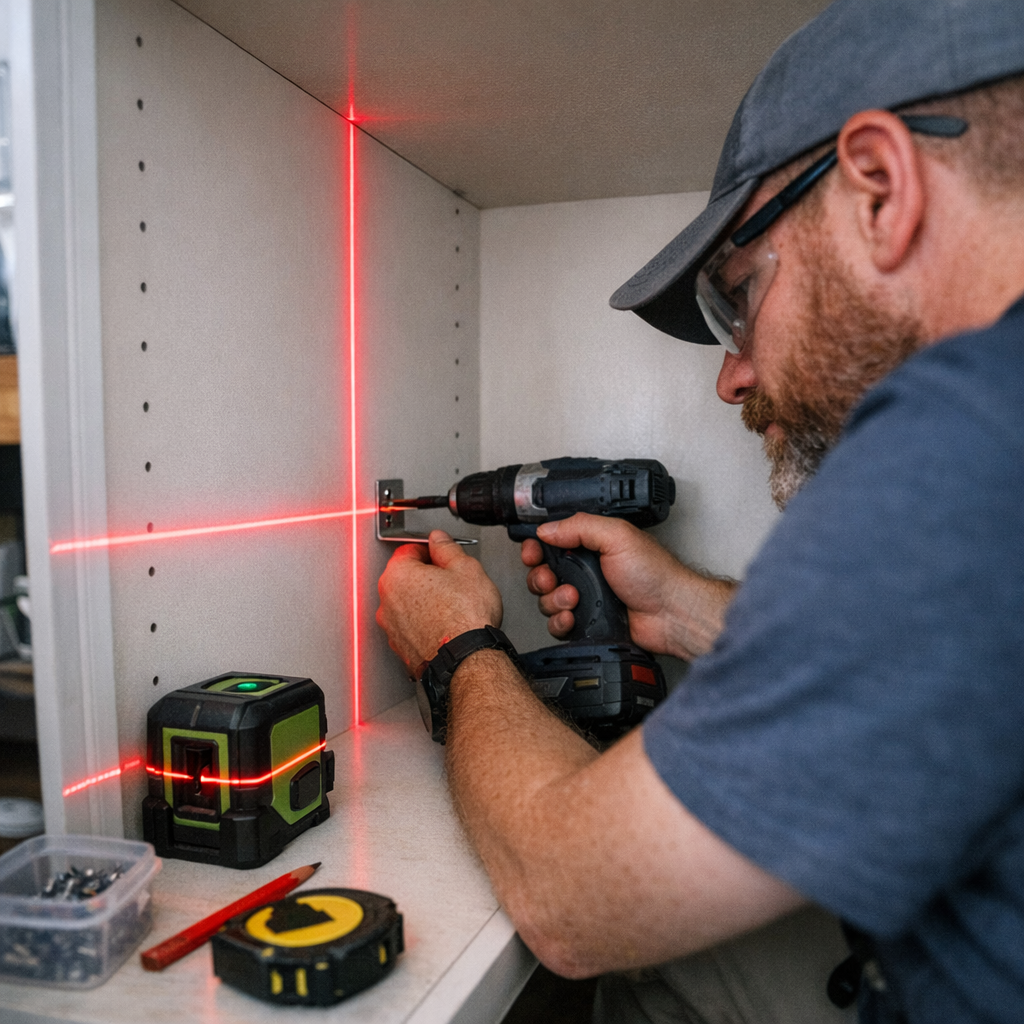
There’s a kind of frustration that creeps in quietly. You enter a cramped cabinet or narrow closet, just trying to finish a project, and suddenly the tools you’ve always trusted begin to let you down. The lines you depend on—a simple laser beam—go soft at the edges, blur, drift. You don’t notice it immediately.
But you feel it.
It’s odd how subtle a misaligned shelf can be, how a bracket that’s just a hair off is enough to stick in your mind every time you open the door. Working in close quarters with a standard laser level, what always worked perfectly on an open wall now produces unpredictability, ghosting, strange reflections. The margin for error seems to shrink with the space, until every minor drift or distortion becomes magnified.
The Subtle Consequence of Close Quarters
Of course, almost every laser level can project a line from one end of a living room to the other. But things change when the surfaces nearly touch—inside a 70-centimeter alcove or a shallow kitchen cupboard. Beams that looked crisp on plaster suddenly split and double, catching on door faces and bouncing from shiny hardware.
You might find yourself checking, adjusting, and rechecking. First, it’s just a touch of sanding, a little more pressure on the screwdriver. Then the gaps start to show. Slowly, the clean outcome you envisioned is chipped away by invisible fractions—a bracket out by two millimeters, a shelf never quite flush.
Funny how these nearly invisible errors are the ones you remember most.
Realizations in Reflection and Drift
I remember the built-in shelf that started this reflection. Confident, I set my laser across the narrow width and marked the endpoints. After drilling and fixing, I stood back and saw it—a slight angle, almost imperceptible but impossible to unsee once noticed. Every added shelf repeated the problem, the drift multiplying.
It hit me then: the traits of a laser level that matter in open rooms, like advertised range or self-leveling flash, aren’t the ones you feel in a closet or under-counter space. Here, it’s about minimum operating distance, the width of the beam, and whether the projection stays sharp with no extra fuss. The “good enough” that works in the open quickly becomes “just wrong” in these tight margins.
There’s a moment after a few retries—a quiet exhale—when you realize the difference isn’t in your skill, but in the tools built for these close thresholds. Switching to a laser designed for short throws and fine lines changed everything. Alignment happened on the first try, and the need for last-minute adjustments faded. The line, just 1.5 millimeters thick, barely wavered even as I moved the unit from side to side.
That small choice was an unexpected kind of relief.
Small Details, Lasting Impact
If there’s a single thing I’ve noticed, it’s that working in tight quarters asks for more patience. The right laser doesn’t remove the challenge entirely—but it does make the finish feel earned rather than wrestled into place. The room for error—the literal space—shrinks, and with it, the excuses for mistakes.
Precision here isn’t about perfection. It’s about avoiding a slow buildup of corrections—a gentle sanding here, a frustrated nudge there—and instead, letting the confidence in your line remain.
In these moments, I find myself slowing down, careful and steady. The work feels different, as if respecting the constraints is its own kind of skill.
This small insight came after realigning hardware—again—inside a stubborn, narrow cabinet. If you’re curious about the tools that made the difference, this is what I used.



