When Small Travel Habits Shape Your Journey’s Flow
Carry-on organization proves itself during travel: separating documents, tech, and comfort items reduces overlap, friction, and delays.
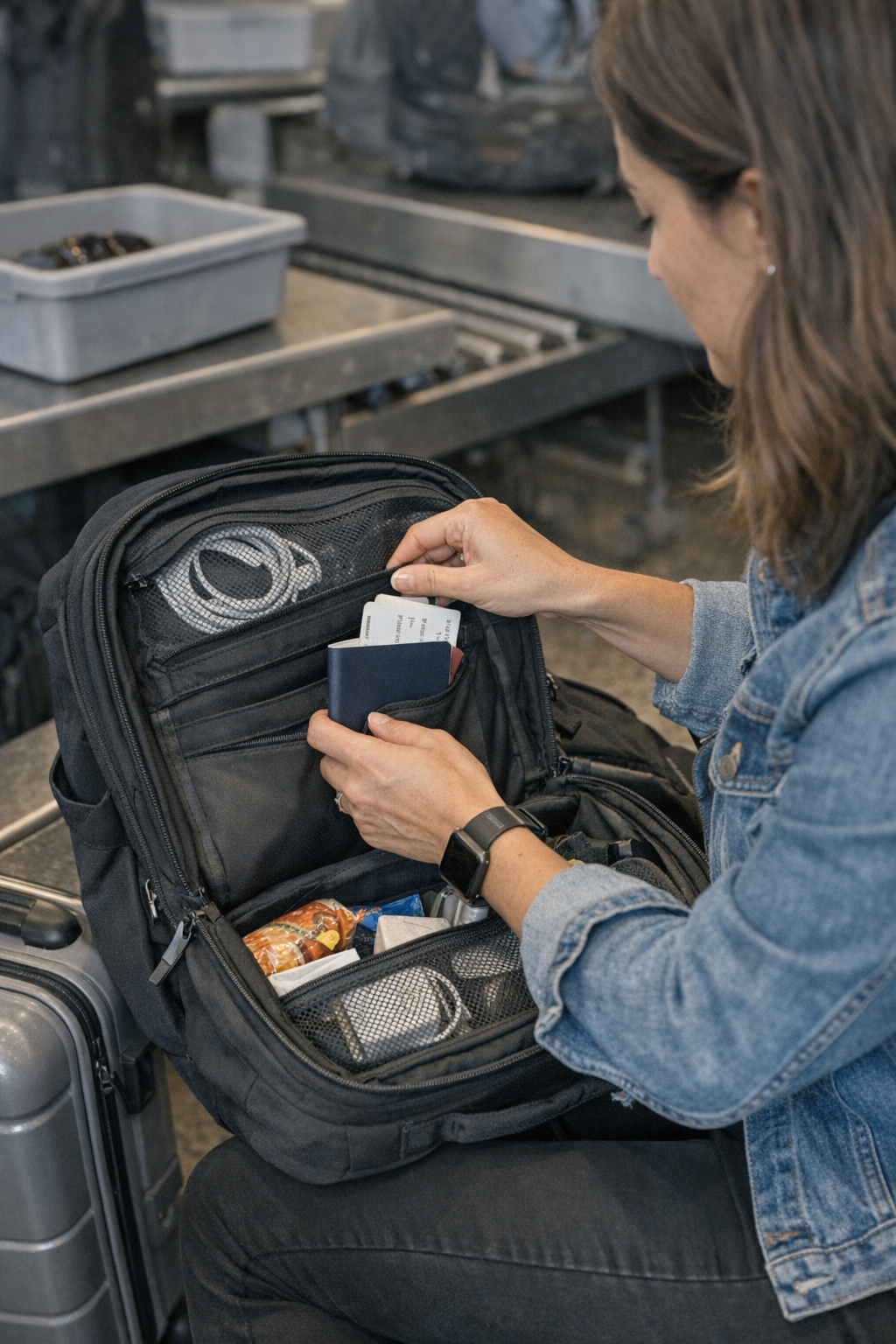
It took a few trips to realize how much time I was losing—not in hours, but in those small, half-glanced struggles each time I had to reach inside my carry-on. There’s a difference between a bag that looks tidy on your bedroom floor and one that’s actually easy to live out of while moving from gate to gate. That line between “organized” and “frustrating” only appears in motion—usually mid-reach, with a line forming behind you at security or boarding.
Where the System Looks Fine—Until It’s Not
You notice it after a few transitions.
Pouches stacked too neatly, the outer pocket looking composed—everything works at first. Until the airport asks to see your boarding pass, then your charger slips behind loose papers, a bag of snacks wedges itself awkwardly, and the neat setup becomes layered and sticky. The bag looks organized crossing the first checkpoint, but by the second or third, the small overlaps multiply. Each rummage repacks things unevenly, compressing items until reaching for anything feels like pulling apart the seams.
What kept coming back was the energy spent hunting the one thing needed right then, blocked by everything else packed to be “convenient.”
What Routines Really Show
The close calls stack: cables tangled with passport, headphones mixed with receipts, snack wrappers slipping into document sleeves—all while shuffling sideways in narrow aisles or pausing quietly at security, making others wait as you dig out your ID.
It looked fine at first. Over and over, the same pattern repeated. But then I noticed what actually sped things up: when categories—tech, documents, comfort—weren’t forced to share the same cramped corner of fabric.
The small change arrived quietly: passport in a back slot, zip headphones above it, no doubling up. After that, at the third checkpoint, I was reaching once instead of three times. It didn’t feel like I’d cracked perfect packing—just that I’d stopped fighting my own setup.
The Gravitational Pull of Friction
Organized chaos is real—and you feel it with every forced pull on the main zipper or every attempt to wedge a charger alongside snacks. The friction shows up as sighs, as slow pauses, as awkward pauses caught in half-closed trays or while dodging elbows in the aisle.
But the difference was clear.
There’s no perfect separation, no magic arrangement. Things slide, pockets bunch, pouches get compressed. But when each essential carved out its own lane—a travel document pocket, a dedicated home for cables and comfort items—the bag stopped feeling like a new puzzle every time I opened it.
It didn’t just look controlled; it let the next transition come without resistance.
Maybe it’s always something small and structural that lets the whole routine breathe a little easier.