When Storage Stops Working in Everyday Life
Functional storage shows after daily use when categories stay clear, enabling quick resets and easier routines with minimal fixing or stacking.

There’s a quiet kind of hope in a freshly organized closet. Shelves lined with bins. Rows of baskets. Each category in its place, every edge tidy. For a few days, it feels effortless—a simple order that promises ease.
But then life continues. Reset after reset, that order becomes less certain. You don’t notice the difference immediately—there’s just a whisper of friction each time you reach for something. Clutter isn’t loud. It sneaks in, bit by bit, turning a system you once trusted into more work.
The Subtle Creep of Disorder
Most storage looks great at first glance. On day one, there’s a clear rightness to everything: scarves folded just so, socks corralled, nothing out of line.
But real life isn’t static. Bins shift each time you nudge them. A divider, meant to keep belts apart from ties, slips sideways. Monday’s neat arrangements get pushed and pulled through the week.
You don’t notice it immediately.
But you feel it.
A stack that leans by Friday. Socks where belts should be. The irritation is soft but persistent—routine actions now require just a little more fixing, a few extra seconds. Edges blur; the system you trusted asks for attention you didn’t expect to owe.
Where Storage Really Fails (Even When It Looks Fine)
It’s easy to mistake neatness for functionality. When every bin fits perfectly edge-to-edge, there’s comfort in the uniformity—until using it proves otherwise.
Real-life use interrupts the photo-perfect setup. Pull one item, the rest wiggle; try to replace something, and the boundaries fight back. It’s a quiet realization: storage that needs constant minor corrections isn’t actually working for you.
One day, you find yourself stacking one bin atop another to make space, wedging socks in with winter hats, hesitating before putting things away because it feels like a puzzle now.
Crowding, it turns out, has a cost measured in small, repeat frustrations. Storage systems meant to simplify end up asking for more time, more effort, more resetting.
A Subtle Shift That Changed Everything
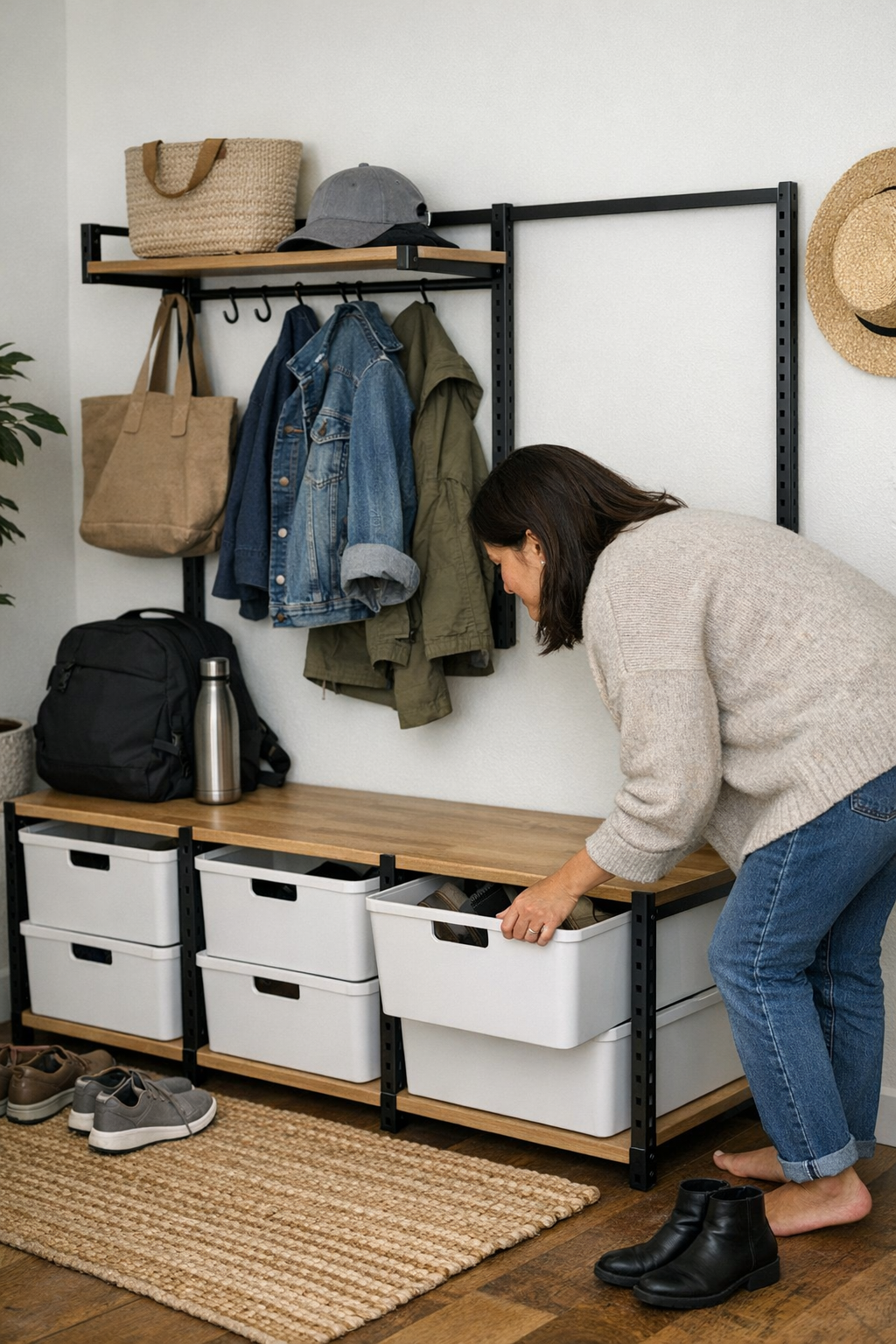
Not long ago, I decided to let go of perfection and simply removed the upper row of bins altogether. The middle shelf—within my easy reach—became my main focus. Nothing needed to be restacked. Everyday items slipped in and out without hesitation.
It sounds almost too simple. But here’s where the real refresh began: by letting each category breathe, I stopped battling the slow creep of chaos. My mornings eased up. I spent less time fixing, more time moving on.
Effortless resets make the difference. When storage works, you don’t really notice it. Life moves through it smoothly, and the order quietly holds.
Most good ideas don’t announce themselves. They just fit naturally—like a shelf at the right height, waiting for you.
These thoughts came together while reworking a corner of my own closet.