When Tired Days Reveal the Truth About Your Closet
Designing storage for tired days means clear access, stable categories, and fast resets, keeping closets organized even on busy, low-energy days.

We all admire a closet that looks pristine—the crisp lines of shelves, bins stacked just so, everything in its place. It feels like a moment of order in a noisy world. But the real test of a closet isn’t how it looks on the best days. It’s how that space holds up when you come home exhausted and still need to function.
You don’t notice it immediately. But you feel it—how a storage system either works gently alongside your routine, or quietly resists you at the seams.
The Hidden Moments of Strain
The first signs appear quietly. One evening, a deep storage bin is just a little too hard to reach. Last night’s bag joins scarves and hats in an awkward tangle. Folding slows, stacks slouch toward the floor. At first, it feels minor. Over time, these little frictions become personal reminders: what’s easy on organizing day is rarely easy on the average Thursday.
There’s a small irony here. What seems perfectly ordered in the moment can feel almost antagonistic when you’re running on empty. Even a beautiful closet starts to work against you, especially when routines are no longer fresh or focused.
What Daily Habits Reveal
It’s easy to focus on fitting everything perfectly—matching bins, symmetrical shelves, maximizing every inch. But daily life rearranges what matters. For me, the real turning point was seeing how often I’d restack the same pile, or leave something draped over a chair because getting it back “in order” was just a little too much effort.
You might not realize it the first time. But when it’s the end of the workday and you hesitate, already knowing what’s easiest is rarely what’s correct, that’s the signal something isn’t working.
Sometimes, all it takes is a small shift—a bin moved to the right height, a divider added where routine needs it most. Suddenly, resets are instinctive, not chores. The system adapts to you, instead of you adapting to the system.
When Storage Supports You
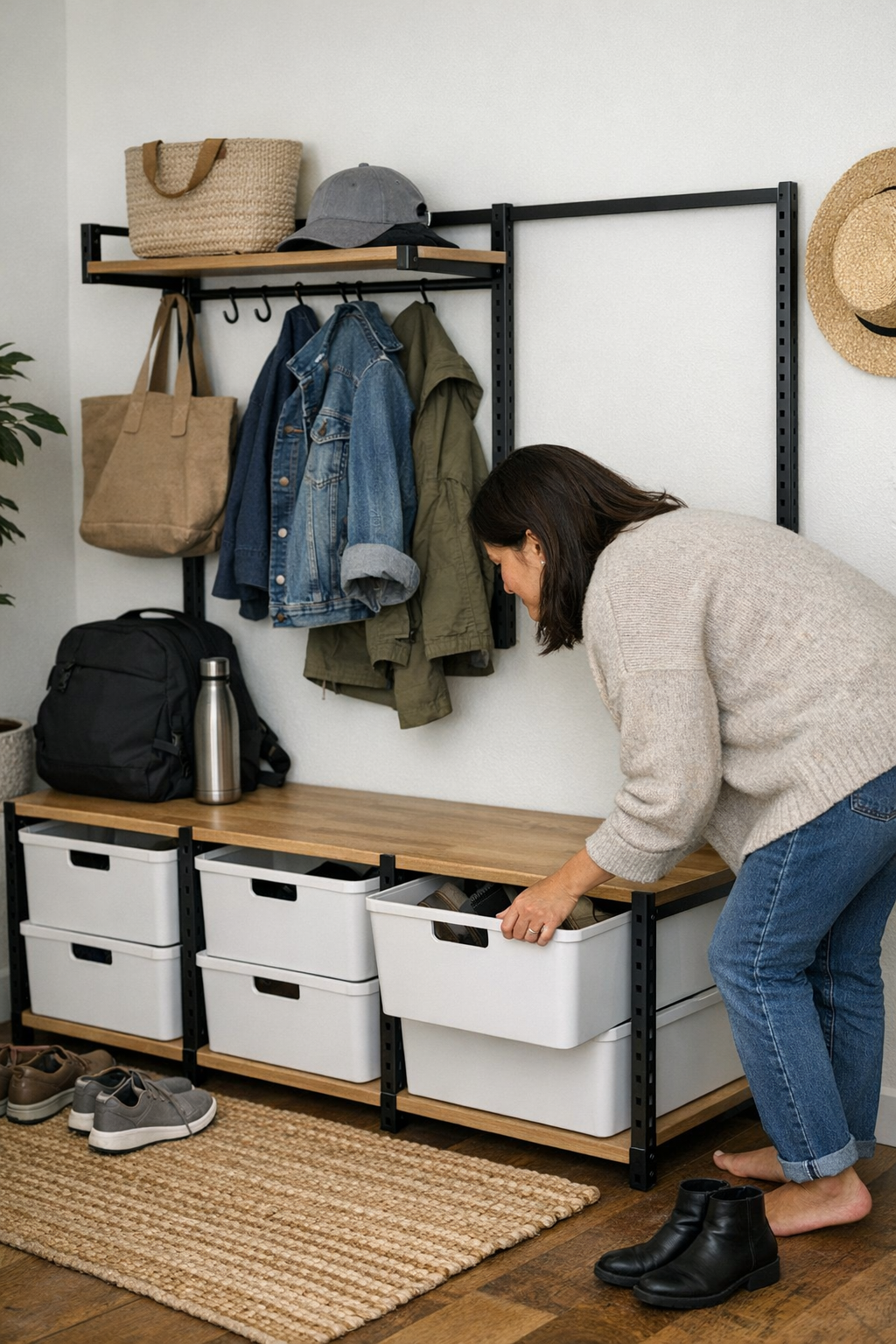
I swapped a deep covered bin for an open-front one with a divider. What I noticed wasn’t just visual tidiness—it was how much more likely I was to return things, even if I was tired or distracted. It took fewer decisions, less shuffling. That subtle sense of relief lingers, almost like the space is quietly on your side.
If you find yourself avoiding resets, or letting clutter gather at the edge of a shelf, perhaps the design is solving for looks and space rather than for ease and daily tiredness. It can feel like a small thing, but once storage feels effortless, the whole evening softens at the edges.
In the end, the best closet I’ve had made little promises: less time finding, less time fixing, and a steady comfort that waits there, day or night.
Choosing storage that supports—not just when things are going well, but especially when they’re not—changes the quiet story of a space. And sometimes, that’s all it has to be.
These realizations came together while rearranging my own tiny hallway closet.